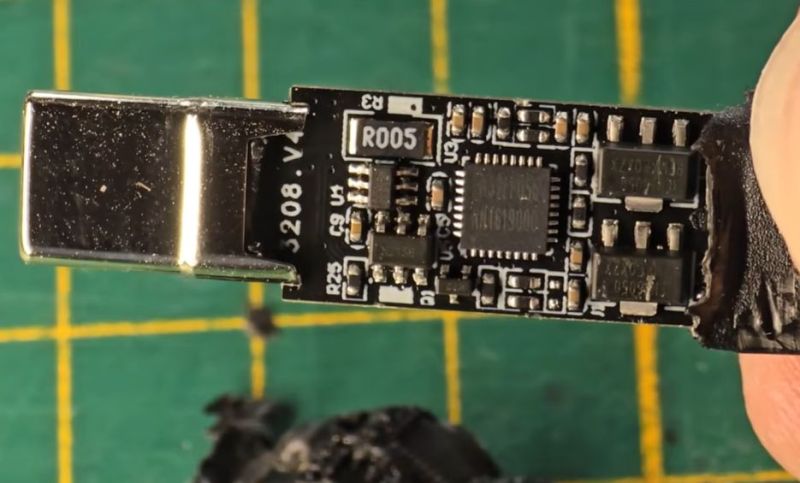
Teardown of an USB-C Cable with Integrated LCD
The past years we have been seeing screens pop up in many new places, but seeing them in USB-C cables is still a bit of a novel thing. Out of sheer curiosity [Aaron Christophel] recently took apart one of these, to see what’s inside and what else you can do with them beyond fondling its single touch control and watch reported voltages and current.
Naturally, these devices aren’t exactly meant to be serviced by anyone, so the biggest challenge is to get into them without too much violence. Risking a blood sacrifice to the Hardware Gods, [Aaron] first attacks the display cover of this €15, 240 Watt-rated UGreen cable with sharp utensils before just taking apart the aluminium case, which ultimately gets him inside.
After this it’s clear that attacking the display cover was the right way, just requiring knowing where to apply pressure in order to invert the assembly process. Following that it’s less clear how it was assembled, though it may have involved liberal amounts of glue after sliding in the components. Rather than bothering with applying heat, instead some side-cutters quickly take care of that pesky aluminium shell.
The tiny IPS LC display is attached via a flat flex cable to...
Teardown of an USB-C Cable with Integrated LCD
The past years we have been seeing screens pop up in many new places, but seeing them in USB-C cables is still a bit of a novel thing. Out of sheer curiosity [Aaron Christophel] recently took apart one of these, to see what’s inside and what else you can do with them beyond fondling its single touch control and watch reported voltages and current.
Naturally, these devices aren’t exactly meant to be serviced by anyone, so the biggest challenge is to get into them without too much violence. Risking a blood sacrifice to the Hardware Gods, [Aaron] first attacks the display cover of this €15, 240 Watt-rated UGreen cable with sharp utensils before just taking apart the aluminium case, which ultimately gets him inside.
After this it’s clear that attacking the display cover was the right way, just requiring knowing where to apply pressure in order to invert the assembly process. Following that it’s less clear how it was assembled, though it may have involved liberal amounts of glue after sliding in the components. Rather than bothering with applying heat, instead some side-cutters quickly take care of that pesky aluminium shell.
The tiny IPS LC display is attached via a flat flex cable to...